
Ask ChatGPT for the best dental clinic in Al Barsha or a good marketing agency in Dubai and it gives a short list with a few names and a reason for each. For the business on that list, it is the new first page of Google. For everyone else, the customer never even sees them.
There is no ad slot to buy and no form to fill in. AI assistants build their answers from what they can read about you on the web: your website, your Google and map listings, directories, reviews and what other sites say about you. The work is making sure that picture is clear, consistent and convincing.
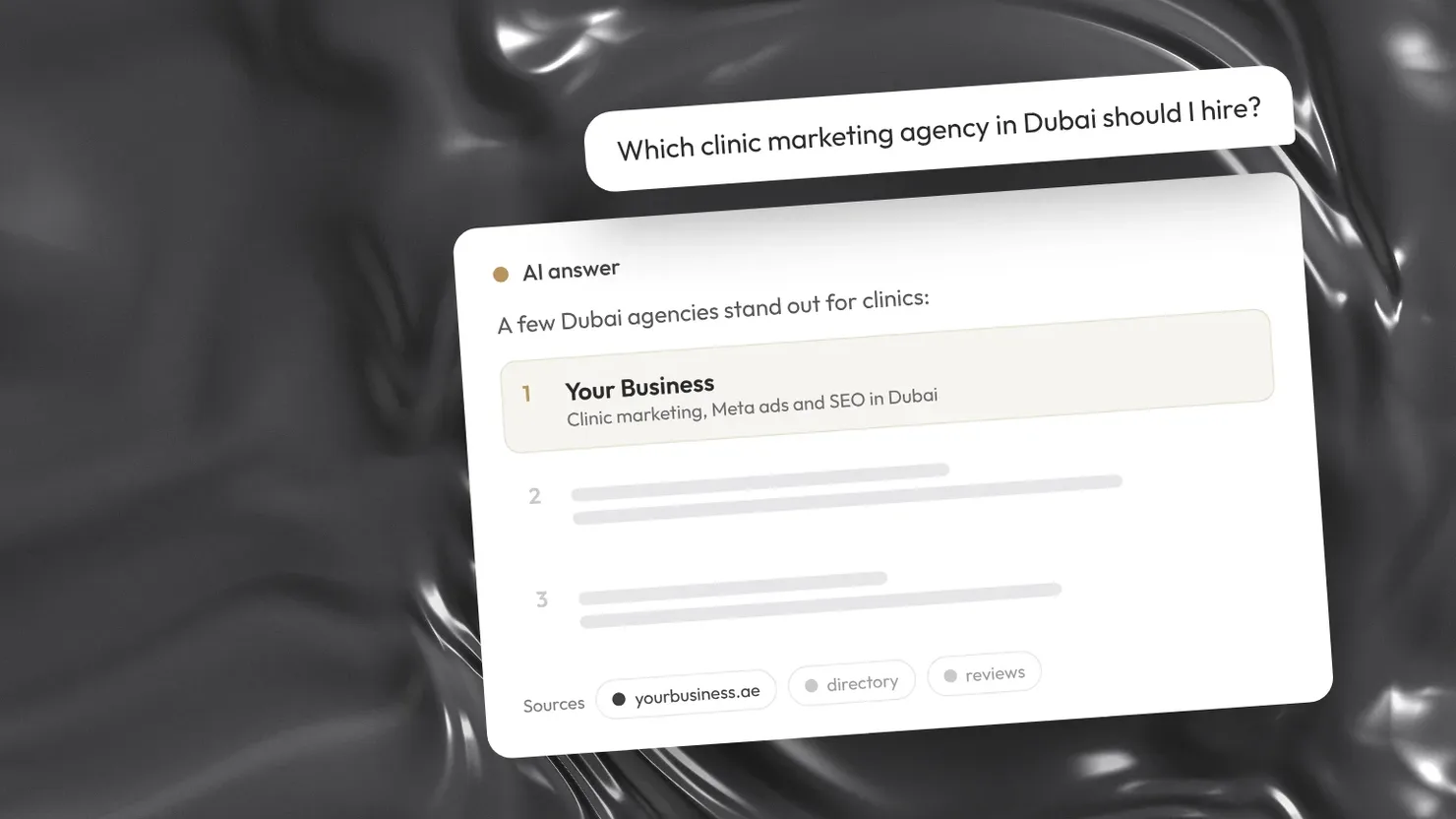
How AI assistants choose which businesses to mention
- They search the live web. ChatGPT search uses its own crawler, OAI-SearchBot, and OpenAI says sites that block it will not appear in ChatGPT search answers.
- Google's AI uses Google's index. Google says there is nothing extra to add for AI Overviews or AI Mode. A page has to be indexed and eligible to show with a snippet, so normal SEO decides it.
- They look for agreement. When your website, Google Business Profile, directories and reviews all describe you the same way, an assistant can state it with confidence. Mixed messages get you left out.
- They quote clear answers. Pages that answer a real question directly, with specifics such as areas served, services and how the process works, are far easier to cite than vague marketing copy.
- Local answers lean on map data. For near me questions, assistants pull from map and listing data. ChatGPT's map results have been reported to use Mapbox data, which in turn draws on sources such as OpenStreetMap and business listings.
Step 1: Let the AI crawlers read your website
Check your robots.txt file. Many websites block AI crawlers by default through a security plugin or a hosting setting, often without the owner knowing. If OAI-SearchBot, PerplexityBot or Claude-SearchBot are blocked, those assistants cannot read your site when they search. Ask your developer to confirm they are allowed, and that your firewall or CDN is not blocking them either.
Then make sure Google and Bing have actually indexed your pages. Submit your sitemap in Google Search Console and Bing Webmaster Tools. Bing matters more than most UAE businesses think, because Microsoft Copilot runs on it and other AI tools use its results too.
Step 2: Say exactly what you do, for whom and where
An assistant can only recommend you for things your website clearly says. "We offer innovative solutions" gives it nothing to work with. "Pediatric speech therapy in Dubai Healthcare City for children aged 2 to 12, in English and Arabic" does.
- Give every main service its own page, named the way customers ask for it.
- State the areas and emirates you serve in plain words, not only in a map widget.
- Open each page with a two or three sentence answer to the question that page is about.
- Add an FAQ section with the questions customers actually ask you on WhatsApp and the phone.
- Keep the facts current: opening hours, address, services you have stopped or added.
Step 3: Make your business details match everywhere
Your name, address, phone number, hours and category should be identical on your website, Google Business Profile, Apple Business, Bing Places and the main UAE directories. If one site says you are in Deira, another says Karama and a third lists an old number, the assistant cannot be sure which is right, so it often picks a competitor whose details agree.
- Claim and complete your Google Business Profile with real photos, services and a description that matches your website.
- Add the same details to Apple Business, Bing Places and Foursquare. They feed the maps inside iPhones, Copilot and many other apps.
- List on the directories that matter for your industry in the UAE, and keep a record of every listing so you can update them all when you move.
- Add Organization or LocalBusiness structured data to your website that matches what the page shows.
Step 4: Earn reviews and mentions that say something
Assistants trust what other people say about you more than what you say about yourself. A steady flow of genuine Google reviews matters, and so does what those reviews say. "Great service" helps a little. "They replied on WhatsApp within minutes and booked my daughter's assessment the same week" tells an assistant what you are good at.
- Ask every happy customer for a review, and make it easy with a direct link.
- Reply to reviews, including the critical ones, calmly and specifically.
- Get mentioned on sites your customers read: local news, industry associations, partner pages and roundup articles.
- Answer questions where people ask them, such as community groups and forums, as yourself and without a sales pitch.
Step 5: Publish content that is worth quoting
The pages assistants cite most are the ones that answer a question better than anyone else. For a UAE business that usually means local, specific and honest: what a treatment involves and how long recovery takes, what permits a brand needs to run influencer ads, how long SEO takes in Dubai. Write what you would tell a customer face to face, add real numbers where you have them, and name your sources.
Comparisons and how to choose guides are especially useful, as long as they are fair. A page that only praises you reads like an ad. A page that explains who each option suits, yourself included, reads like advice, and that is what assistants like to quote.
Step 6: Check what the assistants say about you
Every month, ask ChatGPT, Gemini, Copilot and Perplexity the questions your customers would ask, such as the best physiotherapy clinic in JLT or a branding agency in Dubai for a new restaurant. Note who gets mentioned, which sources are cited and whether anything said about you is wrong. The cited sources show you where to get listed or mentioned next. A wrong fact usually means one of your own pages or listings is out of date.
What does not work
- Paying anyone who promises a guaranteed spot in ChatGPT. Nobody controls those answers.
- Writing separate pages only for AI. Google warns against scaled content made for ranking, and assistants prefer pages written for people.
- Stuffing keywords. The research that coined generative engine optimisation found keyword stuffing made visibility worse, while citing sources and adding statistics improved it.
- Fake reviews. They break Google's rules, and a profile that gets flagged loses trust with every system that reads it.
Where to start this week
- Check your robots.txt and confirm the AI crawlers are allowed.
- Make your name, address, phone and hours match on your website and Google Business Profile.
- Rewrite the first paragraph of your homepage and main service pages so they say exactly what you do, for whom and where.
- Ask five recent customers for a review.
- Ask ChatGPT about your industry in your area and write down who it recommends.
This is the work we do as an AI SEO agency in Dubai, alongside traditional SEO and content. If you would like to know how your business shows up in AI answers today, ask for a free marketing audit and we will include what ChatGPT and Google's AI say about you.
Sources
Razal Mohammed is the founder of Ads n' Codes and leads its AI automation and WhatsApp agent work.